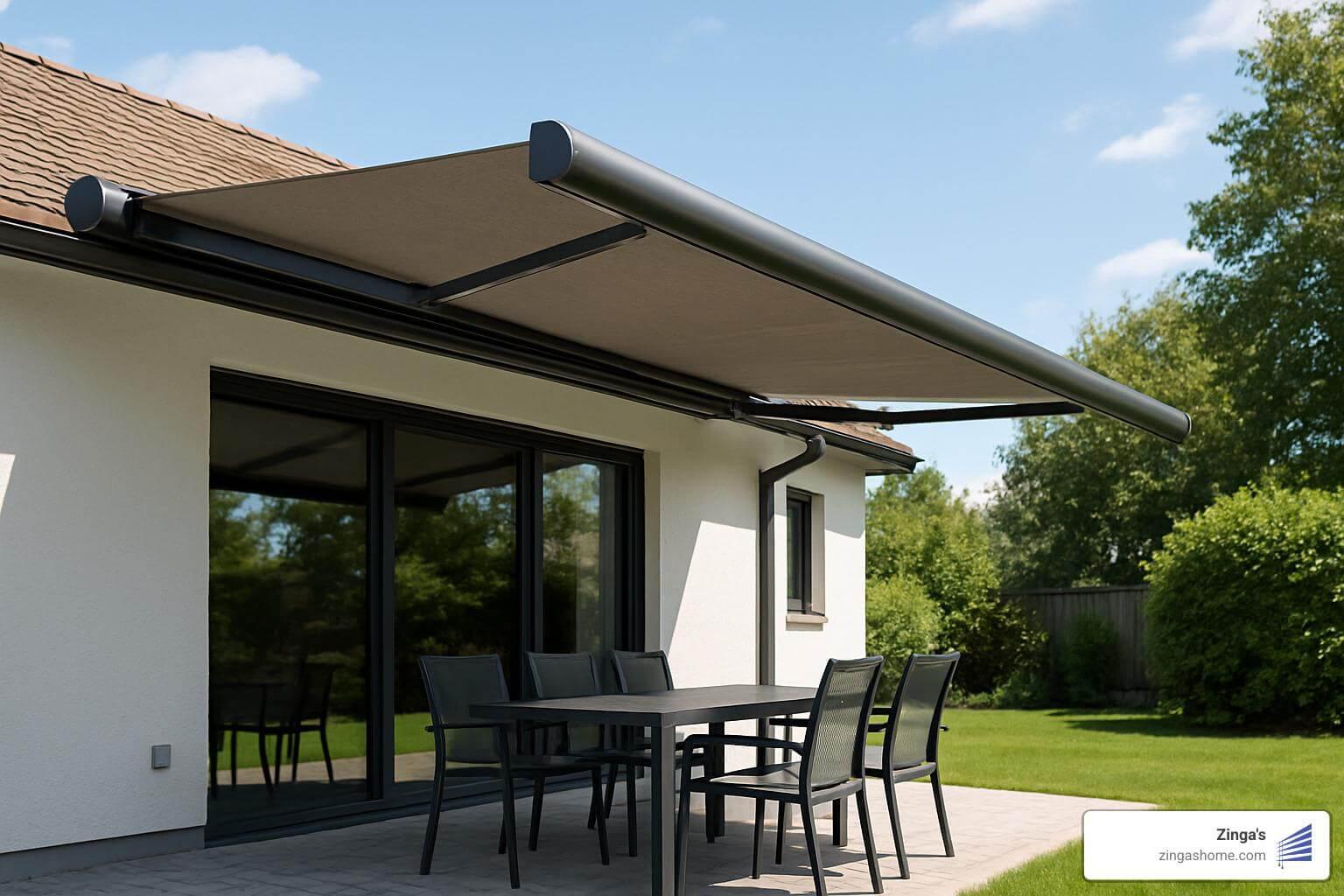
A retractable awning is an adjustable outdoor shade system that extends over a patio, deck, balcony, or other outdoor space when you need protection from direct sun and retracts when you want a more open view of the sky. Depending on the system, retractable awnings can be operated manually or with a motor, remote control, sensors, and compatible smart home controls.
That flexibility is what sets a retractable awning apart from permanent overhead structures. If direct afternoon sun makes your patio uncomfortable, you can extend the awning and create shade. When the sun moves, or you want an open view overhead, you can retract it.
But the right awning depends on more than picking a fabric you like. Size, projection, sun exposure, mounting location, fabric, operation, wind exposure, and automation can all affect how well an awning works for your home.
If you're considering one, here's what to know about the different types of retractable awnings, how they work, their benefits, and how to choose the right setup for your outdoor space.
What Is a Retractable Awning?
A retractable awning is an exterior covering that extends outward from a home or other structure to provide temporary shade. It is much more than a simple sail or roller shade, as a frame and retractable arms support the fabric and roll back toward the building when the awning is closed.
Most residential retractable awnings are installed over areas such as:
- Patios
- Decks
- Outdoor dining areas
- Outdoor kitchens
- Balconies
- Poolside seating areas
- Windows and sliding glass doors
The keyword is retractable.
A fixed awning stays in place, while a retractable awning lets you control when the area is covered. That makes it a useful option when you want shade during the hottest or brightest parts of the day without permanently covering the outdoor space.
Retractable awnings are also different from pergolas and permanent patio roofs. Those systems create a more substantial outdoor structure. A retractable awning is primarily an adjustable shade product.
For many homeowners, that creates an appealing middle ground: shade when you need it and open sky when you don't.
How Do Retractable Awnings Work?
A retractable awning looks fairly simple when it's extending over a patio, but several components have to work together to keep the fabric supported, properly tensioned, and able to retract smoothly.
Fabric and Roller Tube
The visible canopy is made from an outdoor-rated fabric attached to a roller tube.
As the awning retracts, the fabric rolls around this tube. When the awning extends, the fabric unrolls as the arms move outward and support it over the patio or deck.
Because the fabric lives outdoors, it needs to handle conditions very different from those of an indoor textile. Sun exposure, moisture, dirt, temperature changes, and repeated rolling and unrolling all matter when choosing awning fabric.
Retractable Awning Arms
The arms extend outward from the mounting area and support the front of the awning.
Many retractable patio awnings use articulated arms that fold as the awning retracts and open as it extends. Tension within the arm system helps keep the fabric stretched across the covered area.
The arms are one reason a retractable awning can create a large shaded area without requiring posts at the outer corners of the patio.
Frame, Front Bar, and Mounting Brackets
The awning frame connects the different components, while the front bar runs across the leading edge of the fabric.
Behind it all are the mounting brackets that secure the awning system to the home or another approved structural surface. Because an extended awning creates significant leverage away from the wall and is exposed to outdoor forces, proper structural attachment is a crucial part of installation.
Manual and Motorized Operation
Depending on the model and control system, operation may be as simple as pressing a button on a remote or using a hand crank to extend and retract the system.
Compatible motorized systems can also offer features such as wind sensors or smart home controls.
Neither approach is automatically right for every homeowner.
The better choice depends on the size of the awning, how frequently you'll use it, your budget, and how much convenience or automation you want.
What Are the Different Types of Retractable Awnings?
You'll often see retractable awnings described in several different ways. That's because “type” can refer to the operating system, housing, or application.
Manual Retractable Awnings
Manual retractable awnings extend and retract using a hand-operated crank.
- Advantage: Simplicity. There is no motor or electrical work required for normal operation, and homeowners who only expect to adjust their awning occasionally may find a manual system perfectly adequate. Manual operation can also reduce the initial cost compared with an otherwise similar motorized system.
- Tradeoff: Convenience. Extending a large awning by hand takes more effort than pressing a button, and homeowners may be less inclined to adjust a manual awning several times throughout the day.
A manual retractable awning may make sense when:
- You prefer simple mechanical operation.
- You don't expect to adjust the awning frequently.
- Motorization and automation aren't priorities.
- You're looking to keep the initial investment lower.
Manual shouldn't be treated as another word for inferior. It's simply a different way of operating the same basic type of shade system.
Motorized Retractable Awnings
Motorized retractable awnings use an electric motor to extend and retract the canopy.
For the homeowner, the main difference is convenience. Instead of using a crank, you can operate the awning with a compatible remote or other control.
Motorization becomes particularly useful when an awning is large or used frequently.
Imagine that direct sun reaches your patio every afternoon around 2 p.m. By early evening, the sun has moved behind the house, and you'd rather have an open view overhead.
If changing between those two conditions takes only the press of a button, you're more likely to use the awning exactly when you want it.
Motorization can also make additional features possible. Depending on the system, these can include:
- Remote control
- Wind sensors
- Smart home integration
- Voice control
- Other compatible automated controls
Zinga's Z-Glide retractable awnings, for example, can be configured with remote or smart home integrated voice control, as well as a wireless wind sensor that can help retract the awning when wind picks up.
We'll look more closely at sensors and automation later in this guide.
Full-Cassette Retractable Awnings
The cassette is the housing around the rolled fabric and operating components when the awning is retracted.
With a full-cassette design, the system retracts into a more completely enclosed housing.
That helps shelter the fabric and components while the awning isn't being used and creates a clean, contained appearance against the home.
Full-cassette awnings can be attractive when exposure and component protection are priorities.
Semi-Cassette Retractable Awnings
A semi-cassette provides partial protection when the awning is retracted rather than enclosing the system to the same extent as a full cassette.
Depending on the awning, mounting location, and exposure, this can provide a useful balance between protection, design, and cost.
The important question is how much protection the installation needs and which housing options are available for the awning you're considering.
Retractable Patio Awnings
“Retractable patio awning” usually describes the application rather than a fundamentally different operating system.
These awnings extend from the home over a patio, deck, outdoor dining area, or similar space. They can be manual or motorized and may use different cassette and control configurations.
The goal is the same: create useful shade over an outdoor area without permanently covering it.
Remember: Motorization and Automation Aren't the Same Thing
This distinction is easy to miss.
- Motorization provides the physical movement.
- Automation determines when that movement happens without you manually operating the awning.
A motorized awning controlled only with a remote is motorized but not necessarily automated.
Add a compatible wind sensor, for example, and the system can respond to certain conditions by signaling the awning to retract.
So when comparing awnings, don't stop at “Is it motorized?”
Ask what controls and automation options are available and which ones would actually be useful for the way you live.
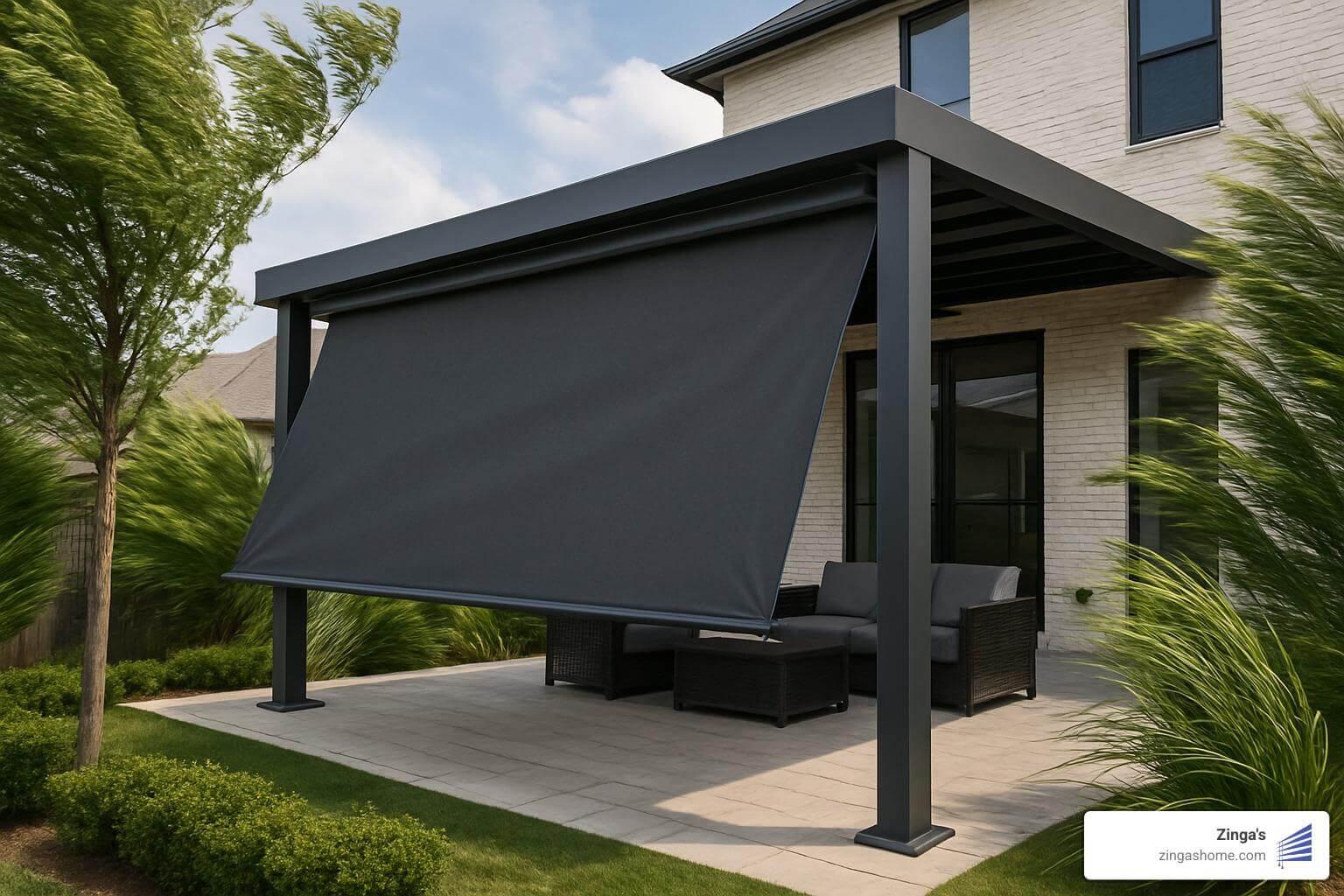
Retractable Awning Fabrics: What Should You Look For?
Fabric has a major effect on how a retractable awning looks, but appearance is only part of the decision.
An awning fabric spends its life outdoors. It has to cope with sunlight, changing temperatures, moisture, airborne dirt, repeated movement, and long-term UV exposure.
That means a fabric that looks good in a sample book still needs to be appropriate for exterior use.
Outdoor Fabric Composition
One material you'll commonly encounter in quality retractable awnings is solution-dyed acrylic.
With solution-dyed fibers, color is incorporated during the manufacturing of the fiber rather than simply applied to the surface afterward. This construction is widely used for outdoor fabrics because of its resistance to fading and weather exposure.
The exact fabric available depends on the awning manufacturer and model.
Zinga's currently offers Sunbrella fabric options with its Z-Glide retractable awnings.
Homeowners can choose from 30 in-stock fabrics or more than 300 custom options, giving plenty of room to coordinate the awning with the home's exterior and outdoor living area.
UV Resistance and UV Protection Aren't Exactly the Same Thing
These terms are easy to blur together.
- UV resistance can describe a fabric's ability to resist degradation or fading caused by ultraviolet exposure.
- UV protection describes the reduction of UV exposure to the people beneath the awning.
Both can matter, but they're describing different things.
When evaluating a fabric, look at the manufacturer's actual performance information rather than assuming every outdoor fabric provides identical protection.
Choosing Color and Pattern
An awning becomes a noticeable architectural feature when extended, so fabric selection should consider more than a small swatch.
Think about how the color or pattern works with:
- Exterior paint or siding
- Brick or stone
- Roof color
- Window and door trim
- Patio furniture
- Other outdoor shade products
Also consider how the fabric looks from inside the home. A large awning installed over patio doors can become part of the view (and filter all light into the home) from an adjacent kitchen, living room, or dining room when it's extended.
Zinga's in-home consultation process can be particularly useful here because fabric samples can be evaluated against the actual exterior rather than under showroom lighting.
What Is an Awning Valance?
A valance is the section of fabric that hangs from the front edge of some awnings.
Its most obvious role is decorative, but depending on the configuration, it can also provide some additional coverage at the leading edge.
Zinga's currently offers Straight and Sea Wave valance styles with its Z-Glide awnings, allowing homeowners to choose a look that works with the architecture and fabric selection.
Can You Replace Just the Awning Fabric?
In many retractable awning systems, worn fabric can be replaced without replacing an otherwise sound frame and operating system.
Whether a fabric-only replacement makes sense depends on the awning model, compatibility, age, and condition of the frame, arms, roller, and motor.
That's worth remembering when thinking about long-term ownership. Fabric is the component most continuously exposed to sunlight and weather, while a well-maintained structural and operating system may remain serviceable.
What Are the Benefits of a Retractable Awning?
A retractable awning does more than put fabric over a patio. Its biggest advantages come from giving homeowners greater control over sunlight and how they use their outdoor space.
Shade When You Need It
This is the defining benefit.
A permanently covered patio stays covered. A retractable awning lets you respond to changing conditions.
Extend it when direct sun makes lunch on the patio uncomfortable. Retract it when the sun moves behind the house, or you want more natural light reaching the doors and windows behind it.
You aren't choosing between “covered” and “uncovered” forever. You can change the space throughout the day.
A More Comfortable Patio or Deck
Many outdoor spaces have hours when they're much more comfortable than others.
A west-facing patio, for example, may be pleasant in the morning but difficult to enjoy when the afternoon sun reaches the seating area. An awning can create shade during that problem period without permanently changing the character of the patio.
That can make outdoor dining, reading, entertaining, working, or simply relaxing outside more comfortable.
This is important for us at Zinga's: our product isn't the end goal. Using your outdoor space more often is.
UV Protection
An awning can reduce direct exposure to sunlight and ultraviolet radiation in the shaded area beneath it.
That matters for people spending time outside, but it can also help reduce direct sun exposure on outdoor furniture and other materials beneath the canopy.
The level of protection depends on the fabric and product, so specific UV performance claims should always be based on manufacturer data rather than assumed.
Shade for Windows and Glass Doors
A retractable awning can also shade windows or glass doors adjacent to the patio.
Exterior shading is useful because it intercepts direct solar radiation before it reaches the glass. That can help reduce solar heat gain through the shaded window or door during periods of direct sun.
That doesn't turn an awning into an air-conditioning system, and the actual energy impact depends on the home, orientation, climate, glazing, awning dimensions, and usage.
But if strong sun hits a large patio door every afternoon, shading the glass can improve more than the patio experience.
Flexible Outdoor Living
Permanent shade isn't always desirable.
- During cooler weather, you may welcome sunlight on the patio.
- On a mild evening, you may want to see the open sky.
- During the hottest part of a summer afternoon, you may want as much shade as the awning can provide.
A retractable system accommodates all three situations.
That flexibility is one reason retractable awnings work well for outdoor living spaces where conditions and the homeowner's preferences change throughout the day and across the seasons.
Design Flexibility
Retractable awnings are also highly visible exterior products, so customization matters.
Fabric color and pattern, cassette color, size, valance, mounting location, and other details can help the awning look intentional rather than added as an afterthought.
The best result should work both ways: functional enough to solve the shade problem and visually appropriate for the home.
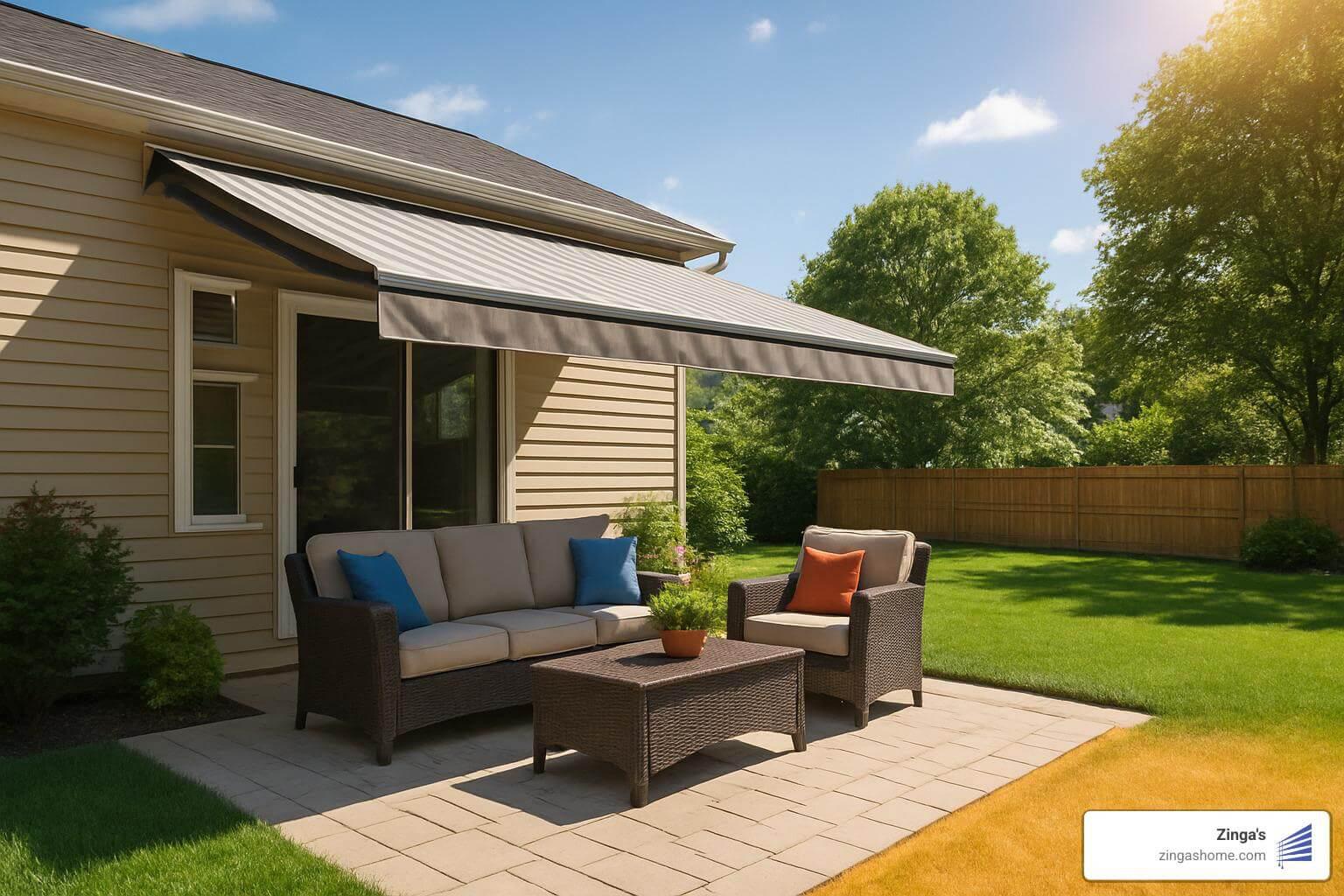
How to Choose the Right Retractable Awning for Your Home
It's tempting to begin by choosing a fabric or comparing motors.
Start with the space instead.
A well-chosen retractable awning should reflect where you need shade, when you need it, how much area you want covered, how exposed the location is, and how you expect to operate the system.
1. Identify Where and When You Need Shade
Stand in the area you're trying to improve and think about when it becomes uncomfortable.
Is the problem:
- Strong afternoon sun over a seating area?
- Direct sun on an outdoor dining table?
- Glare and heat through patio doors?
- Lack of shade around a pool?
- A deck that's comfortable in the morning but difficult to use later?
- Low-angle morning or evening sun?
The sun's position changes throughout the day and throughout the year. That's why the largest awning that physically fits isn't automatically the best awning.
The goal is to create useful shade where and when you actually need it.
2. Understand Width and Projection
Two measurements are especially important when sizing a retractable awning: width and projection.
- Width is the measurement along the mounting surface.
- Projection is how far the awning extends outward from that surface when open.
Projection has a major influence on how much of the patio can be shaded, but a 10-foot projection doesn't mean you'll always have a 10-foot-deep shadow directly underneath it.
The sun's angle affects where that shade actually falls.
That's one reason professional measuring should consider both the physical patio dimensions and the home's sun exposure.
Zinga's current standard Z-Glide awnings are available in widths from 9 feet 6 inches up to 40 feet, with projection options of 8, 10, or 12 feet. Specialized cross-arm configurations are also available for certain dimensions and applications.
Those ranges are useful for understanding the shade protection possible, but the right size should still be determined for the individual space.
3. Evaluate the Mounting Surface
A retractable awning needs a suitable place to attach to the home.
Depending on the system and architecture, mounting options may include approved wall, soffit, roof, or other configurations using the appropriate brackets.
What matters is what lies behind the finished exterior.
The awning has to be attached to suitable structural support, not simply to siding, trim, or another surface that wasn't designed to carry the loads involved.
The mounting location also needs enough clearance for the awning itself and must account for doors, windows, rooflines, gutters, lights, vents, and other exterior features.
Zinga's Z-Glide system offers specialty mounting brackets for roof, soffit, bay, and other mounting situations, but the appropriate option depends on the home.
4. Decide Between Manual and Motorized Operation
Now consider how often you'll actually adjust the awning.
If it normally stays extended for long periods and you don't mind a crank, manual operation may give you everything you need.
If you expect to change the awning throughout the day, have a larger system, want easier accessibility, or are interested in sensors and smart controls, a motorized retractable awning may be worth the additional cost.
Think about behavior, not just features.
A convenience feature has real value when it makes you more likely to use the product the way it was intended.
5. Choose the Cassette Style
Consider how exposed the awning will be when it's closed.
A full-cassette system provides a more complete enclosure of the fabric and components. A semi-cassette provides partial protection.
Architecture and appearance matter too. The cassette remains visible against the house even when the awning is closed, so its dimensions, color, and placement become part of the exterior.
6. Choose the Fabric
Fabric selection should balance appearance with outdoor performance.
Ask about:
- Fabric composition
- UV resistance
- Available colors and patterns
- Manufacturer care requirements
- Warranty
- Fade resistance
- Replacement availability
Then view the fabric against the actual home whenever possible.
A color that looks subtle on a small sample can have a much stronger presence across a large awning.
7. Think About Wind Exposure
A sheltered courtyard and an open elevated deck can experience wind very differently.
Consider the surrounding environment, typical wind exposure, awning dimensions, and manufacturer recommendations when selecting and operating the system.
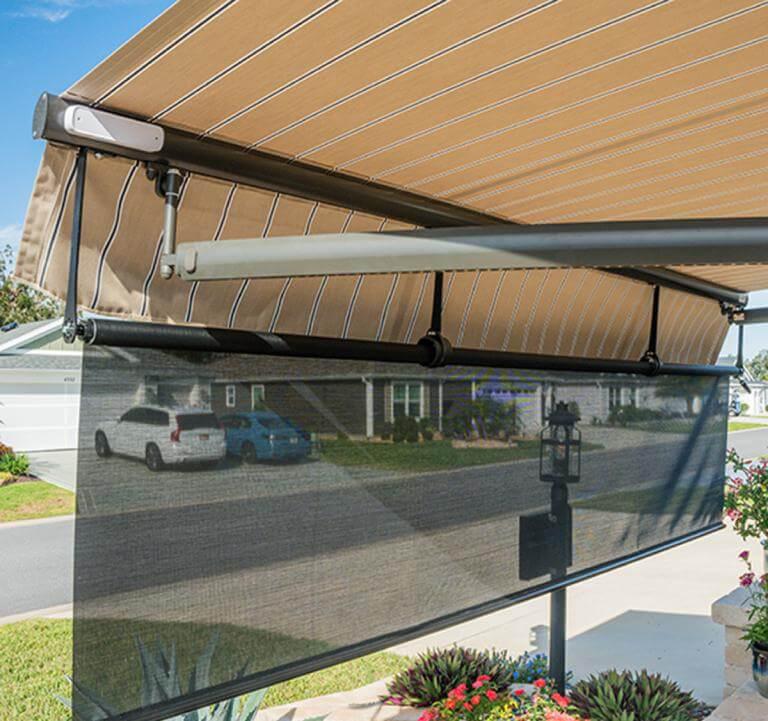
Some installations may benefit from accessories such as compatible wind sensors, wind poles, or front and side screens, which are all available as Z-Glide upgrade options.
But it's important to understand what those features can—and cannot—do.
A retractable awning is primarily a shade product, not storm protection.
8. Decide How Much Automation You Want
A motorized awning can be simple: press the remote to extend it, press again to retract it.
Or the control system can become more sophisticated.
Depending on compatibility, homeowners may have options such as:
- Wireless remotes
- Wind sensors
- Voice control
- Smart home integration
- Other automated controls
Don't add technology simply because it's available.
Ask what problem it solves.
If you regularly forget to retract the awning when the wind picks up, a compatible wind sensor may be useful. If you already control other parts of your home through voice commands, smart integration may make the awning feel like a natural part of that system.
If neither matters to you, straightforward remote operation may be all you need.
9. Consider the Complete Cost
When comparing retractable awning costs, compare complete systems rather than just base prices.
Size and projection affect cost, but so can:
- Fabric quality
- Dimmable LED Lighting
- Specialty mounting brackets
- Additional electrical wiring and installation requirements
- Other accessories
Two awnings with similar dimensions can therefore have very different final prices.
A useful quote should make clear what configuration you're actually buying.
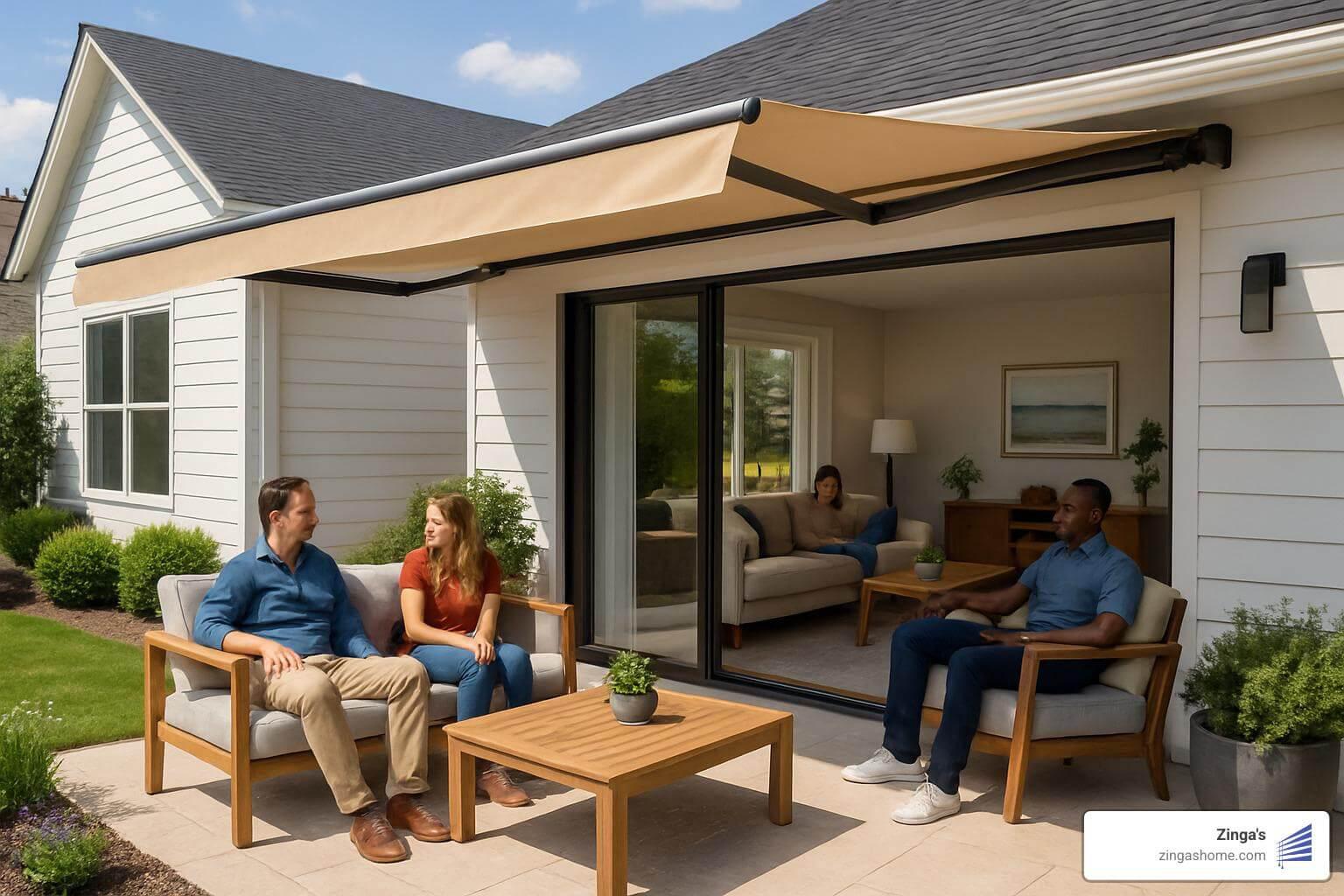
Motorization, Wind Sensors, and Smart Awning Controls
Motorization can make a retractable awning easier to use. Automation can make it more responsive to how you use the outdoor space.
They're related, but they aren't identical.
How Does an Awning Motor Work?
A motorized awning uses an electric motor to drive the roller mechanism that extends and retracts the fabric.
The motor replaces the physical work normally performed through a manual crank.
Depending on the system, it may be controlled through:
- Handheld remote
- Wall control
- Smart home interface
The benefit isn't merely that motors are “high tech.”
It's that opening and closing a large awning becomes easy enough to do whenever conditions change.
Remote Control
For many homeowners, a remote is all the control they need.
If the patio becomes sunny during lunch, extend the awning. If clouds roll in or you want the sky open later, retract it.
Simple controls often provide the most important benefit of motorization without adding unnecessary complexity.
Smart Home and Voice Control
Some motorized awnings can integrate with compatible smart home controls.
Zinga's Z-Glide currently offers remote control or smart home-integrated voice activation as control options.
For a homeowner who already uses smart lighting, shades, thermostats, or other connected products, integrating an outdoor shade can make sense.
The important word is compatible. Smart home support varies by motor, controller, platform, and configuration, so compatibility should be confirmed for the specific system rather than assumed.
Wind Sensors for Automatic Retraction
A compatible wind sensor monitors conditions or movement associated with wind and can signal a motorized awning to retract when its activation threshold is reached.
But a wind sensor should be treated as a backup protective feature, not permission to leave an awning deployed during dangerous weather.
If significant wind or a storm is expected, follow the awning manufacturer's instructions and retract the system as recommended.
Retractable Awning Installation: What Homeowners Should Know
A retractable awning isn't simply fabric screwed to the side of a house.
It's a sizable exterior system that projects away from the structure and must support its own weight while dealing with movement and outdoor conditions. Motorized models also introduce power and control requirements.
Good installation, therefore begins before the awning arrives.
Site Evaluation and Measurements
The installation area should be evaluated for:
- Available mounting width
- Desired projection
- Mounting height
- Structural support
- Doors and windows
- Roof and soffit conditions
- Gutters and downspouts
- Exterior lighting and fixtures
- Sun exposure
- Electrical requirements
- Wind exposure
These factors influence both the awning configuration and where it can safely be installed.
Mounting Requirements
The brackets transferring the awning's load into the building need appropriate structural support.
The exact mounting method depends on the home and awning system. That's why there isn't one universal installation method that applies equally to every exterior wall, soffit, roof, masonry surface, or architectural condition.
Specialty brackets may make additional mounting configurations possible, but the underlying structure still has to be suitable.
Electrical Requirements
Motorized retractable awnings require an appropriate power arrangement for the motor and any powered accessories.
Electrical planning should happen before installation rather than being treated as an afterthought. The exact requirements depend on the motor and system being installed.
Any new permanent electrical work should be completed according to applicable requirements by appropriately qualified professionals.
Programming and Testing
Installation isn't finished when the last bracket is tightened.
A motorized awning should be operated through its full intended range and checked for proper movement and clearances. Remotes and compatible sensors should be paired and tested, operating limits confirmed, and the homeowner shown how to use the system.
That's especially important for automated features. A wind sensor doesn't provide much value if nobody knows whether it's active, how it operates, or how its batteries and settings should be maintained.
Why Professional Installation Matters
Professional installation is less about making the project seem complicated and more about getting several important variables right at the same time.
The awning needs to:
- Fit the available space
- Attach to suitable structural support
- Extend without hitting obstacles
- Provide useful shade
- Operate smoothly
- Meet the system's electrical requirements
- Be properly configured and tested
Zinga's process starts with an in-home consultation and precise measurement, followed by professional installation. That allows decisions about size, mounting, fabric, controls, and accessories to be made for the actual home rather than from generic dimensions alone.
How Much Does a Retractable Awning Cost?
There isn't one meaningful national price for every retractable awning because the final cost depends on the system being built and the conditions where it's installed.
The biggest cost factors typically include:
- Awning width
- Projection
- Model and frame
- Cassette style
- Fabric
- Manual or motorized operation
- Motor and controls
- Smart sensors and automation
- Additional dimmable LED Lighting
- Specialty mounting requirements
- Electrical work
- Installation complexity
A small, straightforward manual awning and a wide motorized full-cassette awning with automation are both “retractable awnings,” but they aren't equivalent projects.
That's why cost is most useful when it's tied to an actual configuration.
Instead of asking only, “How much does a retractable awning cost?”, consider asking:
“What does an awning sized and equipped for my patio cost?”
That produces a much more meaningful answer.
Think Beyond Initial Price
Upfront price still matters, but consider how you'll use the product over time.
A less expensive configuration isn't necessarily the better value if it's inconvenient enough that you rarely use it. Conversely, paying for automation you don't need doesn't improve the awning simply because it adds features.
Good value comes from choosing the size, fabric, operation, and accessories that match the way you'll actually use the space.
How Much Wind Can a Retractable Awning Handle?
There is no single wind speed that is safe for every retractable awning.
Wind performance can vary based on the awning model, width, projection, mounting method, installation, fabric, arm system, wind direction, and whether the wind is steady or gusting.
That's why universal statements such as “retractable awnings are safe up to X mph” can be misleading unless they're tied to a specific tested product and configuration.
If a manufacturer provides a wind rating for a particular awning, follow that manufacturer's guidance.
More importantly, remember the product's purpose:
A retractable awning is designed primarily to provide adjustable shade. It is not a storm shelter or hurricane-protection system.
When high winds or severe weather are expected, retract the awning according to the manufacturer's recommendations.
What About Wind Sensors and How Do They Work?
A wireless wind sensor can provide useful backup protection on a compatible motorized awning by triggering retraction when its activation conditions are reached.
Zinga's offers a wireless wind sensor as an accessory for its Z-Glide retractable awnings.
This can provide an additional layer of protection if the wind picks up while the awning is extended.
But a sensor for automatic retraction doesn't make the awning storm-rated, and it is not permission to leave an awning deployed during dangerous weather.
It also shouldn't replace paying attention to weather conditions.
Are Retractable Awnings Waterproof?
Don't assume that “outdoor fabric” and “waterproof” mean the same thing.
Retractable awnings are an outdoor product, so some awning fabrics and systems can indeed handle limited moisture or light rain under appropriate conditions. However, they are primarily designed for shade, and water performance depends on the specific fabric, pitch, installation, and manufacturer's instructions.
Your Awning Needs a Sinker Pitch and Not a Fastball
Pitch matters because water needs somewhere to go.
If water collects on an extended awning instead of draining, the additional weight can place unnecessary stress on the fabric, arms, and mounting system.
Zinga's retractable awnings come with the EZ-Pitch Adjustment mechanism, which lets you adjust the awning's pitch angle to ensure proper drainage during rain and block low morning or evening sun without changing the entire installation.
Heavy rain, thunderstorms, snow, and other severe weather should not be treated as normal operating conditions unless the manufacturer specifically states that the system is designed and rated for them.
When in doubt, retract the awning and follow the care and weather guidance for the specific model.
How to Clean and Maintain a Retractable Awning
Retractable awnings don't need constant attention, but reasonable, proper care can help keep the fabric and operating system in good condition.
Keep Loose Debris Off the Fabric
Leaves, twigs, dirt, and other debris can collect on an extended awning.
Remove loose material carefully rather than allowing it to accumulate or roll into the cassette with the fabric.
Follow the Fabric Manufacturer's Cleaning Instructions
Different outdoor fabrics can have different cleaning requirements.
Use the cleaning method recommended for your particular fabric rather than assuming that stronger cleaning means better cleaning.
Avoid using a pressure washer unless the fabric or awning manufacturer specifically approves it. Excessive pressure can damage fabric or other components.
Let Wet Fabric Dry
If an awning has become wet, allow it to dry when conditions permit rather than leaving damp fabric rolled up for an extended period.
If weather forces you to retract it while wet, extend it again to dry when it's safe to do so.
Inspect the System Periodically
Pay attention to:
- Fabric condition
- Arm movement
- Unusual noises
- Loose or visibly changed components
- Mounting points
- Remote operation
- Sensor or remote batteries, where applicable
You don't need to become an awning technician. The goal is simply to notice changes before they become larger problems.
When Does Awning Fabric Need Replacement?
Fabric eventually shows the effects of years outdoors.
Depending on the material and exposure, signs that replacement may be worth considering include significant fading, tears, stretched or damaged areas, persistent staining, or deterioration that affects appearance or operation.
If the frame and operating system remain in good condition, ask whether a fabric-only replacement is available for your model before assuming you need an entirely new awning.
Is a Retractable Awning Right for Your Home?
A retractable awning can be a strong option when direct sun limits how often you use a patio or deck, but you don't want to permanently cover the area.
It may be particularly worth considering if:
- You want shade during certain parts of the day.
- You still want the option of an open sky.
- Direct sun makes outdoor dining or seating uncomfortable.
- You want to shade patio doors or windows near the outdoor area.
- You value customizable fabric and frame options.
- You want the convenience of motorized operation.
- Your home has a suitable location for structural mounting.
- You want optional controls such as a remote or wind sensor.
It may not be the right product if your primary goal is substantial all-weather or storm protection.
That's also why product selection shouldn't start and end with a catalog.
The right awning needs to work with the home, sun exposure, patio dimensions, mounting conditions, lifestyle, and desired level of control.
Retractable Awning vs. Pergola: Which Is Better?
Neither is universally better. They're different outdoor shade solutions.
Instead, think about the problem you're trying to solve or the experience you're trying to create.
A retractable awning is a good fit when the priority is a flexible overhead shade attached to the home. You can cover the patio when needed and retract the fabric when you want open sky.
A pergola will make more sense if:
- You're trying to create a more permanent outdoor room
- Want a freestanding or structural solution with different weather capabilities
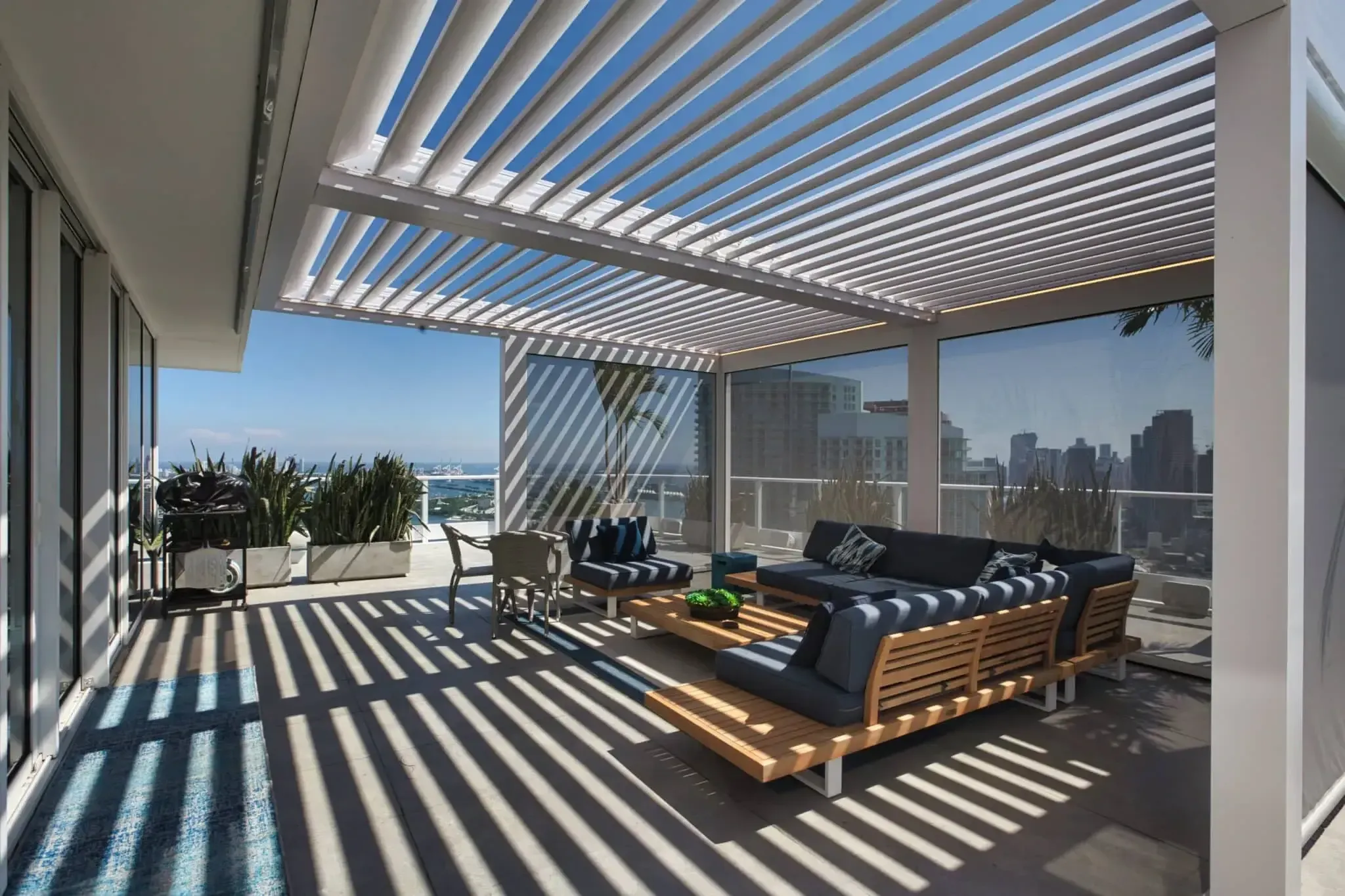
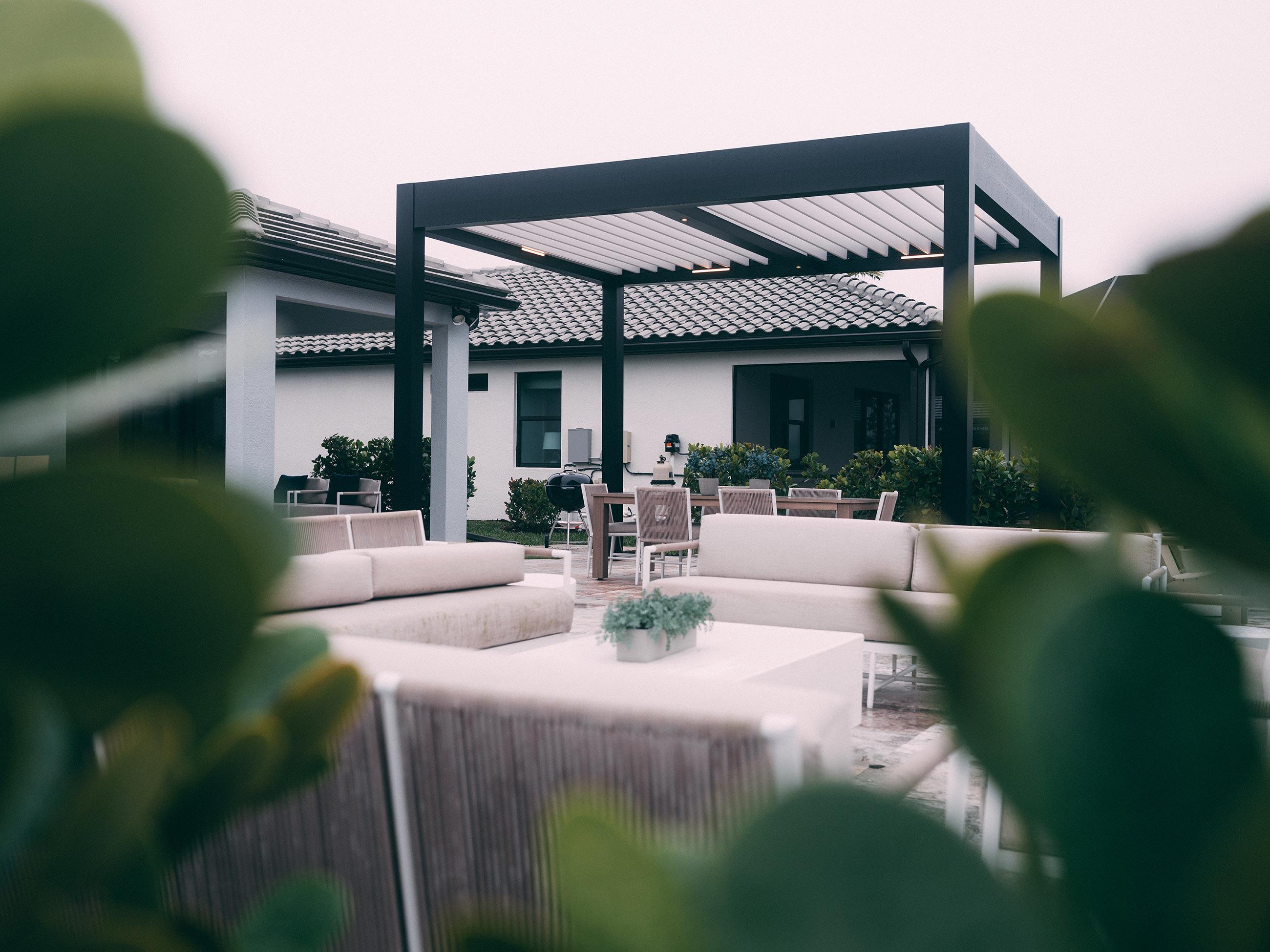
Depending on its design, it can create a defined outdoor room and may offer adjustable louvers, fixed roof panels, or other weather-management features.
The right question isn't “Which product is better?”
It's “Which one solves the problem I have with this space?”
Frequently Asked Questions About Retractable Awnings
What is a retractable awning?
A retractable awning is an adjustable exterior shade covering that extends over a patio, deck, balcony, window, or other area and retracts when shade isn't needed. Residential systems can be manually operated or motorized, with some motorized awnings supporting remotes, wind sensors, and compatible smart controls.
How far can a retractable awning extend?
Projection depends on the model. Zinga's standard Z-Glide awnings currently offer 8-, 10-, and 12-foot projection options. Available width and projection combinations vary, so the appropriate dimensions should be selected based on the mounting area and where shade is actually needed.
Are retractable awnings waterproof?
Retractable awnings should not automatically be considered waterproof. They are primarily shade products. Water performance depends on the specific fabric, system, pitch, and manufacturer guidance. Avoid allowing water to pool on the fabric, and retract the awning during weather conditions outside the manufacturer's recommendations.
Can retractable awnings handle wind?
Retractable awnings can tolerate some normal outdoor conditions, but there is no universal safe wind speed for every model and size. Follow the manufacturer's rating and operating instructions for your particular awning and retract it when high winds or severe weather are expected.
How long do retractable awnings last?
There is no single lifespan that applies to every awning. Longevity depends on fabric, frame, and component quality; sun and weather exposure; frequency of use; installation and maintenance; and whether the awning is retracted during damaging conditions. Individual component warranties can provide more useful information than a generic lifespan estimate.
Are motorized retractable awnings worth it?
Motorization can be worthwhile if you expect to extend and retract the awning frequently, have a larger awning, want easier operation, or want compatible automation such as a wind sensor. Homeowners who prioritize simplicity and lower initial cost may prefer manual operation.
Do retractable awnings need electricity?
Manual retractable awnings generally don't need electricity for operation, except for models with integrated LED lighting, which can be battery-operated. Motorized awnings require an appropriate power source for the motor and powered accessories. Electrical requirements vary by product and installation.
Can a wind sensor automatically retract an awning?
A compatible wind sensor can signal a motorized awning to retract when its activation conditions are met. It is a protective feature, not a guarantee against wind damage, and doesn't make an awning suitable for storms or severe weather.
Can retractable awnings work with a smart home?
Some motorized awnings support compatible smart home or voice-control systems. Compatibility depends on the motor, controller, and platform. Zinga's Z-Glide awnings currently offer remote control or smart-home-integrated voice-activation options.
Can you replace just the fabric on a retractable awning?
Fabric-only replacement is possible on many retractable awnings when the frame and operating system are still in good condition. Availability depends on the manufacturer, model, dimensions, and condition of the existing system.
Can a retractable awning be installed over sliding glass doors?
Yes, retractable awnings are commonly used to shade patios and areas outside sliding glass doors. The installation must provide adequate structural mounting, height, projection, and clearance for the doors and surrounding exterior features.
How do you clean retractable awning fabric?
Remove loose debris and follow the fabric manufacturer's recommended cleaning procedure. Avoid harsh chemicals or pressure washing unless specifically approved. If the fabric gets wet, allow it to dry when conditions permit before leaving it retracted for an extended period.
Should you retract an awning when you're not home?
If changing weather could expose the awning to conditions outside its operating recommendations, retracting it before leaving is the safer approach. Compatible wind sensors can provide an additional layer of protection, but shouldn't be considered a substitute for responsible operation.
What's the difference between a full-cassette and semi-cassette awning?
A full-cassette awning more completely encloses the fabric and operating components when retracted. A semi-cassette provides partial enclosure. The best option depends on exposure, appearance, available models, installation conditions, and budget.
Make Your Outdoor Space Work Better for You
A good retractable awning isn't simply the biggest model that fits on the back of the house.
It should put shade where you need it, fit the architecture, operate the way you prefer, and make the patio or deck more comfortable when you actually want to use it.
That means considering the sun's path, width, and projection, fabric, mounting location, manual or motorized operation, wind exposure, and controls as parts of one system.
Zinga's designs and installs custom retractable awnings for patios, decks, balconies, and other outdoor living spaces. During a complimentary in-home consultation, we can evaluate your space, take precise measurements, show you fabric options, and help determine which size, mounting configuration, and features make sense for your home.
Schedule a complimentary in-home consultation to find the right retractable awning for your outdoor space.